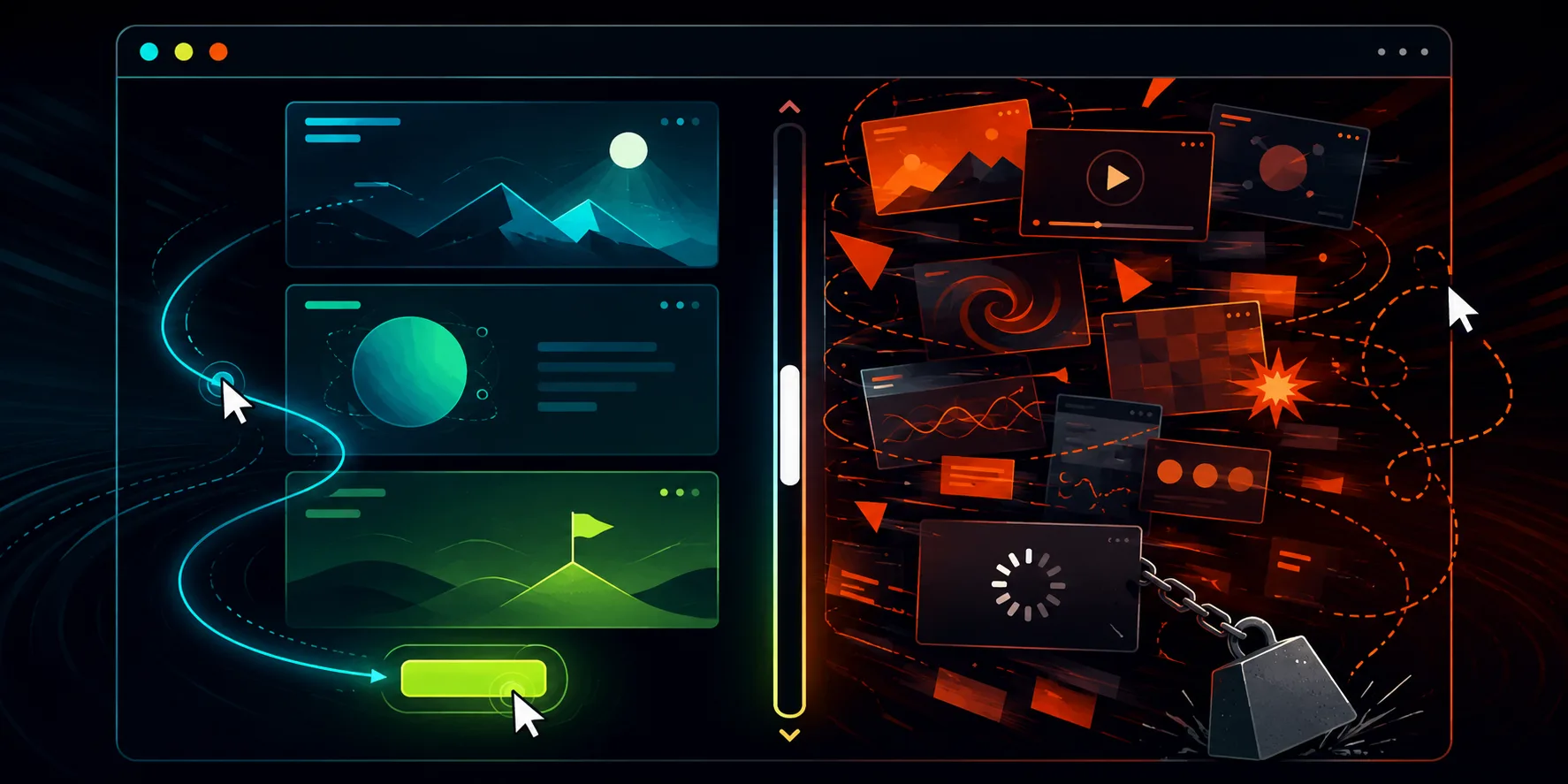
Scroll animation has become one of the most recognizable elements of modern websites in recent years. Elements move as the user scrolls, products rotate in 3D space, text appears at exactly the right moment, and the whole page sometimes works almost like a short interactive story.
When they are well thought out, scroll animations can guide a user's attention, simplify a complex story and create an experience people remember. When they are not, the result is often the opposite: a slow site, a user who does not know where they are, and a handful of impressive effects that help neither sales nor understanding of the product.
So the question is not whether scroll animations are good or bad. The real question is: does the animation have a reason to exist?
What is scroll animation?
Scroll animations are animations triggered or changed by how the user moves through the page. That can be a simple appearance of text or a photograph, but also a much more complex experience in which the scene, the perspective, 3D objects, video, typography or the entire page layout change as you scroll.
In more complex cases the term scrollytelling is often used. The idea behind scrollytelling is that scrolling is no longer only a way for a user to move further down the page, but becomes the way the story unfolds. Instead of showing a user ten pieces of information at once, you can reveal them one at a time, in an order that makes sense.
Why has scroll animation become so popular?
Because a classic website is no longer the only way companies want to present themselves. Among technology companies, creative industries, new products and premium brands in particular, there is a need for the site to be not only a place where information is read, but part of the identity of the product itself.
Users have grown used to very high-quality digital experiences. The line between a website, video, animation and an interactive presentation is less and less visible. Scroll animation makes it possible to build an experience like that directly in the browser, but the popularity of a given effect is not on its own a good enough reason to use it.
Does scroll animation genuinely improve the user experience?
It can, but only when it helps a user understand, notice or remember something more easily. A good scroll animation can direct the eye to an important part of a product, show how a particular feature works, explain a process that would take several screens as a static illustration, or control the pace at which a user receives information.
The problem starts when animation is used as a substitute for good structure and content. If, after an impressive animation, a user still does not know what the company sells, the effect has not done its job.
When does scroll animation make sense?
It makes the most sense when it is part of the communication rather than decoration. Say you are presenting a product that has several stages of use. Instead of writing five paragraphs, you can show visually, as the user scrolls, how the product changes from one step to the next.
Or you are presenting a complex technical system. With animation you can gradually show how its different parts connect. On a brand site the animation can have a different function: to create a feeling, an atmosphere or a visual identity a user immediately associates with the company.
In all those cases the animation is doing something for the content. That is a good starting point.
When does scroll animation become just an effect?
When a user notices it more than the message it is supposed to carry. If every section arrives from a different direction, text flies across the screen, the cursor does one thing, the background another, and products rotate for no clear reason, the user starts following the effect instead of the content.
It is especially problematic when animation slows a user down. If someone only wants to find a price, a contact or a specific piece of information, they should not be forced through thirty seconds of choreography to get to it.
Good motion design does not say: “Look how much animation we can build.” Almost imperceptibly, it says: “Look at this next.”
How much animation is too much for one site?
There is no number of effects beyond which a site is automatically over-animated. Their intensity and frequency matter far more. One complex hero animation can be entirely justified, while twenty small animations on every page can be far more tiring.
A good question we ask during design is: what would be lost if we removed this animation? If the answer is “nothing, it would just be less interesting”, it is worth asking whether we really need it. If part of the story, the hierarchy or the way a user understands the product would be lost, the animation probably has a function.
Does scroll animation slow a website down?
It can, but it does not have to. The mere fact that a site has animation does not automatically mean it will be slow. There is a big difference between a carefully built motion system and a page onto which several large video files, 3D models and libraries have been loaded without much thought.
Performance can be affected by asset size, the amount of JavaScript, the rendering approach, the complexity of 3D scenes, video content and the number of elements animating at once. So performance should not be checked only once the site is finished. If we know motion will be an important part of the experience, it has to be taken into account during design and development.
Is animation bad for SEO?
Animation on its own is not a problem for SEO. The problem arises if the site is built in such a way that a search engine cannot properly find, load or understand important content.
If key text only appears through a complicated interaction, if the content is not properly structured, or if a large amount of script seriously affects performance, animation can indirectly cause a problem.
So a modern animated site and good SEO are not opposing things. What is needed is a normal semantic page structure, clear content and a technically sound implementation behind the visual experience.
How does scroll animation affect GEO?
Much the same way as SEO. An AI system does not care how impressive the transition between two sections looks. What it cares about is being able to clearly understand who you are, what you do, which problems you solve, what experience you have and how the information on the page connects.
So GEO must not be sacrificed to a visual concept. You can have a heavily animated site, but the key information still has to be written clearly. If a company does website, app and business software development, it should say so somewhere. Animation can make that message more interesting, but it cannot replace it.
Are animated sites worse on mobile phones?
Not necessarily, but a mobile device calls for different thinking. An animation that looks fantastic on a large desktop monitor does not have to work equally well on a phone. The screen is smaller, the way people interact is different, device performance varies, and a user often has less patience.
So a well-animated web experience does not mean simply shrinking the desktop version. Some animations should be simplified, some shortened, some changed completely, and some may not be needed on mobile at all.
What about accessibility?
This matters too. Not every user is comfortable with a lot of movement on screen. So when developing animation you have to account for the possibility that a user has reduced motion switched on in their operating system.
Animation should never be the only way a user can reach important information. If content stops being understandable or functional without the effect, there is a problem.
Can scroll animation increase conversion?
It can help, but there is no magic formula in which more animation means more sales. Animation can increase conversion if it helps a user understand the product better, see its value or arrive naturally at the next step.
It can also reduce conversion if it draws attention away from the CTA, makes navigation harder or lengthens the path to the information a user is looking for. So the effect of animation should be judged in the context of the page's goal.
On a landing page for a new product we may want strong storytelling. On a booking page we probably want something quite different: as few obstacles as possible between the user and the action.
Should every business site have scroll animation?
No. It suits some brands very well, while others do not need it at all.
If the main reason for adding it is “we saw it on Apple's site”, that is not enough yet. The question to ask is: what do we want to achieve with this animation?
If you are presenting a new product, want a strong brand impression or have a story that is easier to show than to explain, motion can be very valuable. If a user comes primarily to quickly find technical documentation, a price or a simple piece of business information, complex scrollytelling may only get in the way of what they came for.
Does an Apple-style site make sense for every brand?
No. Apple can use extremely complex visual storytelling because it has products an enormous number of users already know. If a user already knows what an iPhone is, the page can afford to devote far more time to the experience and to product detail.
A company a visitor is hearing about for the first time has a different problem. It first has to explain who it is, what it does and why the user should care.
So copying the visual style of a large brand without understanding its function often does not produce the same result. Inspiration is useful. Copying the logic without the context is not.
What does scroll animation on a site cost?
There is no separate universal price for “scroll animation”. Simple effects can be part of standard frontend development, while complex scrollytelling can require motion design, prototyping, custom frontend development, 3D modeling, asset optimization, dedicated testing and considerably more time.
So the difference between a site with a few subtle transitions and a site that works as an interactive experience can be large. The most important thing is to decide how much motion contributes to the business and creative value of the project before the level of complexity is set.
What does a good process for building an animated site look like?
It does not start with the question: “What animation can we put here?” It starts with the content.
What is the most important message? What should a user see first? What should they learn next? Where should they pause? When should they get the CTA?
Only after that does it make sense to think about how motion can help. A good process therefore connects strategy, UX, design and development much earlier than on a classic static site.
Because an animation a designer imagines has to work well in the browser, on different screens and without seriously affecting performance.
The best scroll animations are often the ones you notice least
It sounds paradoxical, but it matters. The best motion often feels completely natural. A user does not think: “That is an excellent scroll-triggered animation.” They simply keep going, because the page leads them naturally.
When movement has good rhythm, hierarchy and a reason, the whole page feels better made. When it does not, it feels like an effect added after the design was already finished.
So scroll animation should be treated as part of the design, not as an ornament added at the end.
How do you know whether your site needs scroll animation?
Ask yourself a few questions: is there something that is easier to show than to explain, does the animation help a user understand the product, is there a story we want a user to follow in a particular order, does motion contribute to the brand identity, will the experience still be simple to use, and can we maintain good performance.
And perhaps most importantly: would we still want this animation once it was no longer a trend?
If the answer is yes, there is very probably a good reason for it to be there.
Does scroll animation improve a website? It can significantly improve the user experience when it guides attention, explains a product or helps tell a story.
Can it slow a site down? It can, if it is badly implemented, too heavy, or used without a plan for performance.
Is it bad for SEO and GEO? Not in itself. The problem arises if animation makes content hard to reach, the page slow, or the structure unclear to search engines and AI systems.
Should it be used because it is currently popular? No. It should be used when it does something useful for the user or the brand.
A good scroll animation should not only make a user say: “That looks good.” It should help them understand why what they are looking at matters.
Thinking about a site with advanced animation?
Scroll animation, 3D and interactive elements can completely change how a user experiences a digital product, but only if they are part of the idea, the UX and the development from the start.
So on projects like these we do not start from the effect we want to build, but from the story we want to tell and the action we want to lead the user to.
Take a look at how we approach website development, or book a call with our team.