It is a very common dilemma, especially when the business need is clear but the technical solution is not.
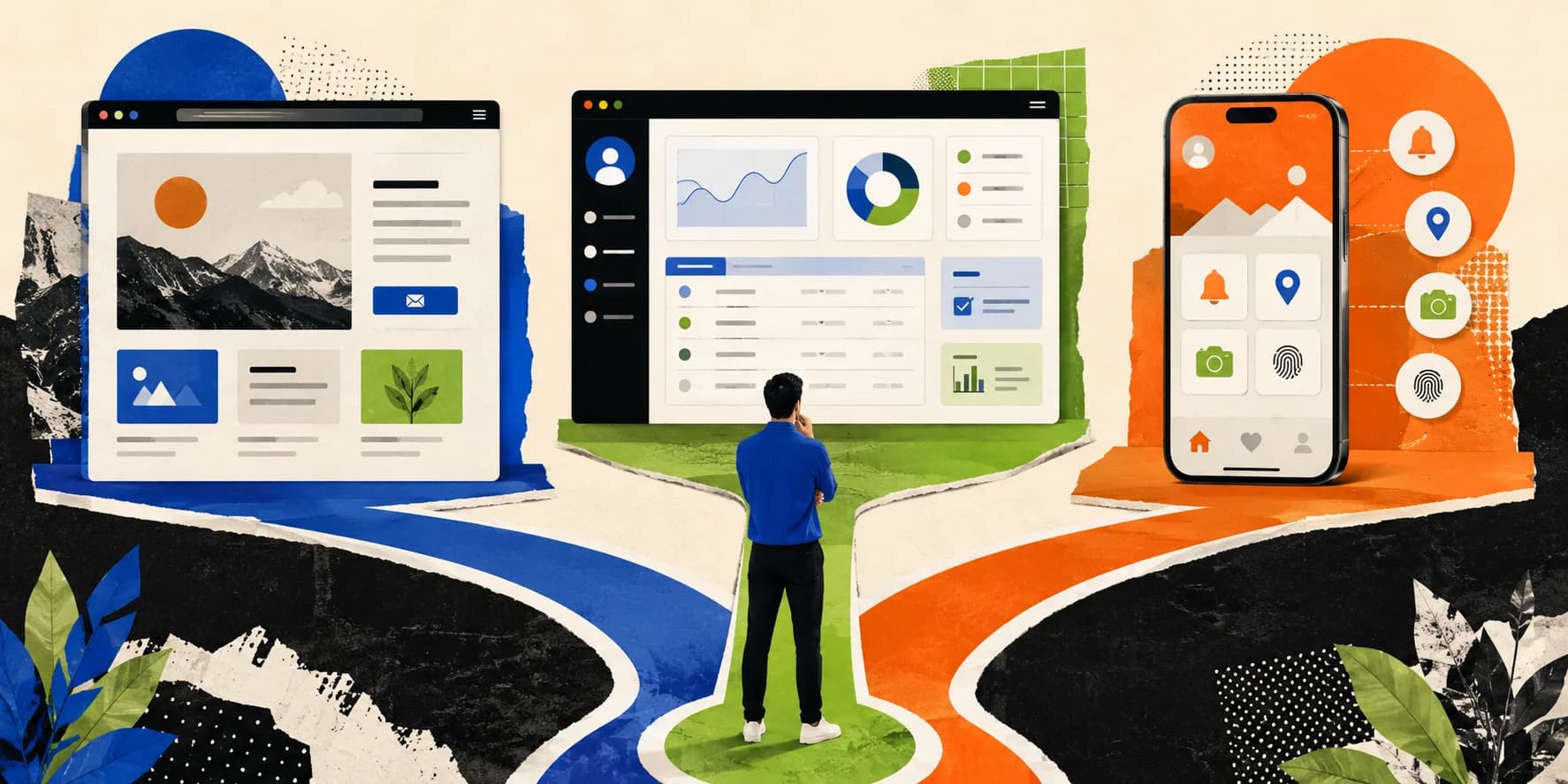
The short answer: if a user primarily needs to find information, get to know your offering or send an inquiry, what you usually need is a website. If a user needs to log in, work with data, carry out tasks or use more complex features through a browser, you more likely need a web app. A mobile app makes the most sense when the product is used often and when phone features matter, such as push notifications, the camera, location or working without an internet connection.
But the lines between these solutions are not always entirely clear.
So do not start from the question:
“What do we want to build?”
It is better to start from:
“What do we want a user to be able to do?”
What is the difference between a website and a web app?
A website is built primarily to present information to a user and let them find what they are looking for.
That can be a corporate site, or the site of a hotel, a medical practice, a company, a brand or a service business.
A user most often arrives to learn:
- what the company does
- which products or services it offers
- how far it can be trusted
- how to get in touch
- where it is located
- what its previous work looks like
- what to do next
A web app, on the other hand, is not meant only for reading content.
In it, a user does something.
They log into an account, enter data, make a booking, track statuses, manage documents, use a dashboard, communicate with other users, generate reports or carry out some other process.
Put as simply as possible:
A website mostly presents information. A web app lets a user get work done.
When is an ordinary website entirely enough?
If the main goal is to present the company and attract potential clients, you most likely do not need an app.
A good business site can do far more than the phrase “an ordinary site” may suggest.
It can have a complex content structure, several languages, a blog, advanced search, contact forms, CRM integration, calculators, event registration or other features.
That does not automatically turn it into an app.
If most users arrive to find information, make a decision and take the next step, a website is probably the right solution.
When do you need a web app?
A web app makes sense when a user has to actively use the system rather than just browse it.
For example, if you want users to have their own accounts and, once logged in, to be able to:
- manage data
- track statuses
- create content
- book appointments
- collaborate with other users
- view personalized information
- generate documents
- manage orders
- pay for services
- run a particular business process
then we are no longer talking about a classic site alone.
An example of a web app can be a booking system, a project management platform, a customer portal, a CRM, a course registration system or an administrative platform for employees.
The advantage of a web app is that a user reaches it through the browser and generally does not have to install anything.
Does a web app have to look like “an app”?
No.
This is a common misconception. A web app can look very much like a classic website. The difference is not primarily in how it looks, but in how it works. If a user is only reading information about their bookings on a page, that can be part of a site.
If they log in, change a booking, manage data, receive personalized information and the system responds to their actions, we are already in web app territory.
When does building a mobile app make sense?
A mobile app makes the most sense when a user uses the product often enough that installing it is a benefit rather than an extra obstacle.
If someone uses a thing once every six months, it is hard to justify asking them to go to the App Store or Google Play first, find the app, install it, log in and keep it updated.
If they use the product every day or several times a week, the situation is different.
A mobile app makes particular sense when things like these matter:
- push notifications
- the camera
- GPS and location
- biometric authentication
- working without an internet connection
- frequent use
- a very fast mobile experience
- features tied to the device itself
In other words, an app should not be built just because “everyone has an app”.
There should be a clear reason why a user would want it on their phone.
Do I need a mobile app if I already have a good site?
Not necessarily.
A good responsive website can meet a great many mobile users' needs without a separate app.
If people mostly arrive from Google, read some information, look at a product or send an inquiry, an app would probably only add unnecessary complication.
A mobile app becomes more interesting when you have users who come back regularly.
For example, if a user books an appointment several times a week, tracks a workout, manages finances, communicates with other users or uses your product on the move, an app can significantly improve the experience.
Which is better: a web app or a mobile app?
There is no universally better choice.
It depends on what you are building. A web app has the big advantage that a user reaches it directly through the browser. There is no installation and it can simply work on a computer, a tablet and a phone. A mobile app requires installation, but in return it can integrate more deeply with the device and offer a better experience for certain kinds of products.
If working on a desktop computer matters to your users, a web app often makes more sense.
If the product is used almost exclusively on a phone and relies on mobile device features, a mobile app can be the better choice.
And sometimes the right solution is to have both.
Do you have to build both an iOS and an Android app?
If you decide on a mobile app, the next question is often whether two completely separate apps have to be developed. Not always. There are technologies that allow one app to be built for several platforms, but the decision depends on the features, the performance and the product's long-term plans. For certain products native development can have advantages.
For others a cross-platform approach is entirely rational and can significantly simplify development and maintenance.
Again, the choice should not start from the technology.
It should start from what the product has to do and who it is for.
What if I need something only for employees?
Then we may be talking about neither a classic site nor a mobile app. What you may actually need is custom business software.
For example, if employees need to:
- run a sales process
- manage tasks
- track production
- keep documentation
- manage inventory
- approve requests
- record work
- follow up with clients
- generate reports
- connect several internal processes
then very often the best answer is a web app that serves as an internal business system.
To an outside user that system may not be visible at all. And that is exactly where the name of the product matters less than the problem it solves. You can call it a platform, a portal, an app or business software.
What matters is that it eases a process that today costs time, money or people.
When is Excel no longer a good enough solution?
Many internal applications actually come about the same way.
A company starts with a few Excel sheets.
Then there are ten of them.
Then there are different versions of the same sheet, data is copied by hand, someone accidentally deletes a column, and an important part of the process depends on one particular person knowing “which file is the right one”.
At a certain point the problem is no longer Excel.
The problem is that the business process has outgrown a tool that was originally enough.
At that stage business software or an internal web app can make far more sense than continuing to build on the existing pile of spreadsheets.
Is a mobile app more expensive than a website?
In most cases a complex app takes more development than a simple business site, but the category of product on its own is not enough to estimate a budget.
A simple app can be less demanding than a complex web platform.
The price is driven by the features, the number of user roles, the integrations, the design, the way data is processed, the administration, security, the platforms and many other factors.
Which is why the comparison:
“What does a site cost, and what does an app cost?”
is not precise enough.
A far more useful question is:
“How complex is the thing we want to build?”
Should you build an MVP first?
If you are developing a new digital idea and do not yet know how users will react, starting from an MVP often makes sense.
An MVP, a minimum viable product, is not “a bad, cheap version of the product”.
A good MVP contains the smallest set of features that lets you check whether the idea genuinely solves a user's problem.
Instead of spending a year developing dozens of features you assume will be needed, you can build the core of the product first, put it in front of real users and decide what to develop next based on data.
This makes particular sense for startups and new business models.
What if I do not know what I actually need?
That is completely normal.
A client should not have to arrive at a development team with a finished technical specification.
You may only know:
“I want our clients to be able to book an appointment themselves.”
or:
“I want employees to stop doing this across six Excel sheets.”
or:
“I want customers to be able to track the status of their order.”
That is a good enough starting point.
A good development team should ask the follow-up questions and work out the simplest solution that achieves the goal.
Which questions should you ask before deciding what to build?
Before choosing between a site, a web app and a mobile app, answer a few questions.
Who will use the product?
Are they potential clients, existing users, employees or partners?
How often will they use it?
Once a year and ten times a day call for completely different approaches.
What does the user need to do?
Read? Buy? Book? Enter data? Communicate? Run a process?
Do they have to have an account?
If the content is personalized for each user, you are probably in app territory.
Are phone features needed?
Location, the camera, notifications or offline use can all be arguments for a mobile app.
Will employees use the product on a computer?
Then a web app often makes far more sense than a mobile one.
Are there other systems the solution has to talk to?
A CRM, an ERP, payments, inventory, accounting and other systems can significantly affect the product's architecture.
The answers to these questions are far more useful than an initial idea that you “need an app”.
The most common mistake: deciding the technology in advance
Sometimes a client arrives with the request:
“We need a mobile app.”
After a conversation it turns out the average user would open it once or twice.
In that case installing a separate app may have no business logic behind it at all.
Another time the request reads:
“We need a new site.”
And what is actually needed is a system employees log into and run their whole business process through.
So the technology should not define the problem.
The problem should define the technology.
Can one project be both a site and an app?
Of course.
It is a very common situation.
You can have a public part of the site that Google indexes and that explains the product.
On the same domain there can be a section users log into that works as a web app.
On top of that you can have a mobile app for the users who need daily access.
These are not three mutually exclusive products.
They can be different parts of a single digital system.
What is best for SEO and GEO: a site or an app?
If you want organic visibility through Google and AI search, publicly available web content plays a very important role.
A classic website lets you have pages dedicated to services, products, customer questions, case studies and other information search engines can index.
A mobile app on its own does not replace that role.
Which is why even companies whose main product is an app often have a serious website explaining what the product does, who it is for and why anyone should use it.
For GEO it is especially important that public content clearly answers the questions potential customers are asking.
An AI system cannot properly recommend something that is nowhere clearly explained on your public site.
How do you choose the right solution?
Do not start from:
“We want an app.”
Start from:
“What do we want a user to be able to do?”
If you primarily want to present the company and attract new clients, you probably need a website.
If you want users to carry out more complex tasks and work with data through a browser, you probably need a web app.
If the product is used often on a phone and relies on mobile features, a mobile app can be the right choice.
If you want to improve an internal company process, what you may actually need is business software.
And if you still do not know which category your idea falls into, that is not a problem you have to solve on your own before the first conversation with a development team.
The short answer
Do you need a website, a web app or a mobile app?
A website is most often the right choice when you want to present the company, content, products or services and attract users.
A web app makes more sense when users have to log in, work with data or carry out particular processes through a browser.
A mobile app is a good choice when the product is used often on a phone and the features of the device itself matter.
And if the solution is primarily meant to improve the way your employees work, it is possible that what you need is custom business software.
The most important thing is to define the business problem and the user first, and only then the technology.
Have an idea but are not yet sure what to build?
You do not have to know in advance whether you need a site, an app or a fully custom system.
It is enough to know what you want to make possible for a user, or what you want to change in your business.
From that, a solution that makes sense can be defined.
Take a look at how we approach building websites, apps and business software, or book a call with our team.