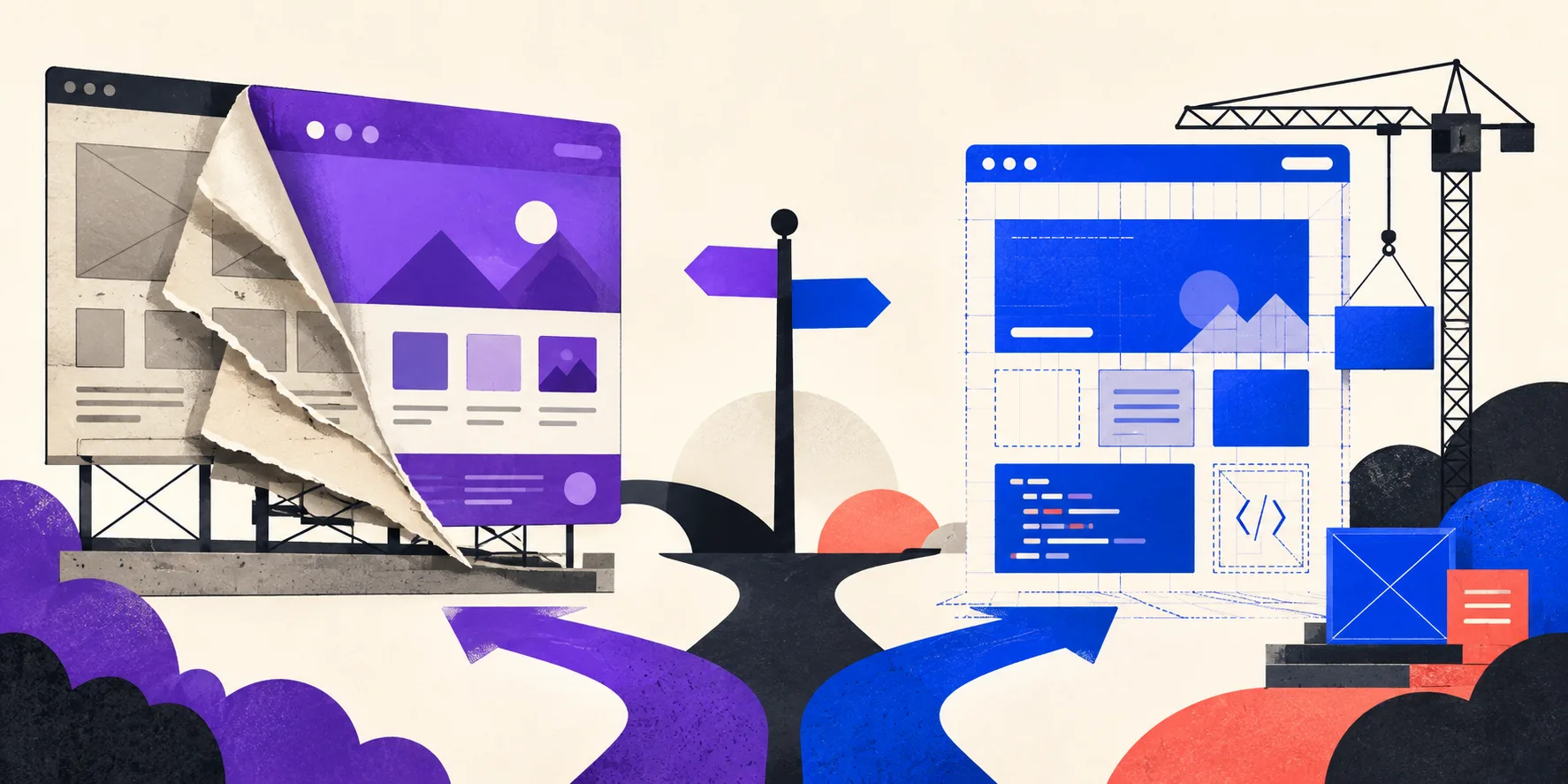
The short answer: if the problem is mostly the look, the content and the user experience, a redesign can be entirely enough. If the existing technology, structure or the way the site works is holding you back, building a new site more often makes sense.
The age of a site is not decisive on its own. A six-year-old site can have a good technical foundation, while a much newer one can need serious work.
So the decision should not rest on how the site looks, but on what does not work today and why.
What does redesigning a site actually mean?
A redesign does not have to mean only changing colors, fonts and photographs.
A good redesign can include a new page structure, different navigation, a change in how you present your services, better-placed calls to action, an improved display on mobile devices and a completely new visual identity for the site, while the technical foundation stays the same.
If the existing CMS, code and infrastructure work well and let you keep developing the site, there is no reason to replace them just because you want a different look.
When is redesigning the existing site enough?
A redesign makes sense when the foundation of the site is good, but the way the company presents itself no longer is.
You may, for example, have changed your services, your target audience or the way you sell over the years, while the site stayed the same.
Users may be struggling to find important information.
The pages may look dated, the CTA buttons may not be clear enough, or the mobile version may have significant room for improvement.
In situations like these there is often no need to tear everything down and start over.
If the technology is stable and supports what you want to build, a good redesign can completely change the way the site works for your business.
When is it better to build a completely new site?
A new site makes more sense when the problem is not only what the user sees.
If every new feature is hard to add, the CMS is complicated to use, the site has serious performance problems, or the existing technology can no longer support what the company needs, a redesign can only paper over the problem.
It is like refitting the interior of a building whose foundations no longer suit what you want to put on top of them.
It can look better, but the limits stay where they were.
How do you tell whether the problem is design or technology?
This is one of the most important questions to ask before a redesign.
If what bothers you is primarily the look, the way content is presented, the navigation or the user experience, the problem can probably be solved with design and by restructuring the content.
If what bothers you, however, is that you cannot easily add new features, connect other systems, change content or scale the platform, the problem probably runs deeper.
A good indicator is how often you hear:
“We can, but…”
We can, but we have to install another plugin.
We can, but that part cannot be changed.
We can, but it will be complicated.
We can, but it will slow the site down.
When the workaround becomes the standard way of building, it is worth asking whether the existing solution still makes sense.
Is an old WordPress site worth redesigning?
Yes, if it is technically healthy and WordPress still suits the needs of the project.
The mere fact that a site was built in WordPress is no reason to build a new one. For many business sites WordPress can be a perfectly good solution. The problem starts when years bring a large number of plugins, custom changes, outdated components and interdependencies that make maintenance harder and harder.
In that case it is not enough to lay a new design over the existing structure.
Before deciding, you should check the state of the theme, the plugins, the system versions, the performance, the way it is administered and the custom code added over the years.
Only then can you realistically tell whether keeping the existing foundation makes sense.
Is a redesign cheaper than building a new site?
Often it is, but it does not have to be.
If you keep the existing technology and most of the features, a redesign can take considerably less development. But if during the project you change nearly the whole structure, the design, the CMS, the code, the features and the integrations, then in practice it is no longer a redesign. It is a new site you are trying to build on old foundations.
In a situation like that, fixing the existing solution can sometimes take more time than developing a new, cleaner one.
So the choice between a redesign and a new site should not rest on the initial price alone.
You also have to look at how easy the solution will be to develop and maintain over the coming years.
Seven signs you probably need a new site
1. Every new feature takes a workaround
If something that ought to be simple turns into a complicated project every time, the existing architecture may be holding you back.
2. The site is slow even after optimization
Images, the server and the frontend can all be optimized, but there are situations where the problem is deeply tied to the way the site was built.
3. Your team struggles to edit content
If changing plain text or adding a new page is a job for a developer, it is worth checking whether the current CMS suits your needs.
4. The mobile version feels like an add-on
Mobile devices today cannot be a version of the desktop site adapted after the fact. The experience has to be planned for different screen sizes from the very beginning.
5. The site structure no longer fits your business
The company has changed, new services, markets or products have appeared, but the site still follows the way you were organized a few years ago.
6. The site cannot connect to the systems you use
If you now want to connect to a CRM, an ERP, inventory, payments or other business tools, the existing technology may no longer be the right foundation.
7. More money goes into fixing than into building
If you keep solving the same problems, you may no longer be investing in the site but in servicing technical debt.
At that point it makes sense to work out what keeping the existing system actually costs you.
When do you definitely not need a new site?
You should not build a new site just because the current one is “old”. If the existing platform runs stably, is easy to maintain, supports the features you need and can keep up with the company's further growth, there is not much sense in replacing the whole technical foundation.
You may only need better content / a new structure / a UX redesign / a new visual identity.
And you may not need a large redesign at all, only a few precise changes to the pages that most affect sales.
A new site is not the goal. A better business solution is.
What if the site gets traffic but not enough inquiries?
That on its own is not a reason for a new site. First you have to establish where the problem is.
Is the right audience arriving?
Does a user immediately understand what you offer?
Are your most important services easy to reach?
Is there a clear next step?
Does a user have enough reason to trust you?
Is getting in touch complicated?
If the technical foundation is good, problems like these can often be solved with better UX, content and a conversion strategy, without building a completely new system.
If, however, the existing platform is the reason you cannot carry those changes out properly, a new site becomes a far more rational option.
What happens to SEO results when you build a new site?
This is one of the most important questions in a migration.
A new site should not simply be put live without analyzing what already exists.
If there are pages Google already indexes and that bring in traffic, their value has to be preserved.
That means mapping old and new URLs, correct redirects, keeping important content, metadata, internal structure and the other elements that affect organic visibility.
A badly executed migration can cause a drop in organic traffic even when the new site is visually and technically far better.
So SEO should not be bolted on at the end of a redesign. It has to be taken into account while the new structure is still being planned.
The same goes for GEO. If you want Google and AI systems to clearly understand your services, a new site structure is an excellent opportunity to organize the content around users' questions and needs from the start.
Should the existing content be kept?
Not automatically. Migrating an old site is not a house move where everything that exists is simply carried across to a new address.
A redesign is a good opportunity to check what users actually need, what brings traffic, what brings inquiries and what no longer serves any business purpose.
Some pages should be kept, some merged, some expanded, some removed, and some written completely from scratch.
The quality of a new site depends a great deal on how well this decision was made before the design began.
What does assessing an existing site before a redesign look like?
Before deciding between a redesign and a new site, you should look at at least four things.
The business side: what do you want the new site to achieve that the current one does not?
The user side: where do users run into trouble and what is missing for them?
The technical side: how stable, fast and adaptable is the existing solution?
The SEO side: which pages already hold value you do not want to lose?
Only when those are looked at together can a rational decision be made. There is no rule that a site of a certain age is automatically thrown away.
So how do you decide between a redesign and a new site?
Ask yourself one simple question:
Does the existing site merely represent us badly, or does it genuinely hold us back?
If it mostly represents you badly, a redesign is probably a good place to start. If it holds you back in sales, marketing, content, integrations or further development, a new system is worth considering.
And before you decide, do not start from the question:
“Do we want WordPress or Next.js?”
Start from the question:
“What do we want to be able to do with the new site?”
The technology comes afterwards.
The short answer
Is it better to redesign the existing site or to build a new one?
If the technology and the structure are sound and the problem is primarily the look, the content or the user experience, a redesign can be entirely enough.
If the existing system makes development, integrations, maintenance or reaching new business goals harder, building a new site is often the more rational choice.
The most expensive option is not necessarily a new site.
Sometimes the most expensive option is spending years patching a solution the company has already outgrown.
Not sure what makes more sense for your existing site?
Before any decision about technology or budget, you first have to establish what currently works, what does not, and what you want to change.
On that basis you can judge whether it is better to keep the existing foundation or to start over.
Take a look at how we approach website development and redesign, or book a call with our team.