CAPTCHA started with a very simple idea: give a task that a person solves easily and a computer cannot.
The problem is that computers have changed a lot since 2000, the year CAPTCHA appeared.
Even more interesting, that progress also changed what it means to “prove you are human.”
How did it all start?
CAPTCHA stands for Completely Automated Public Turing Test to Tell Computers and Humans Apart. Researchers at Carnegie Mellon University coined the term and built the first systems around 2000. Among them were Luis von Ahn, Manuel Blum, Nicholas Hopper and John Langford. The goal was to stop automated programs that opened accounts in bulk, sent spam or abused web services.
The principle was elegant. The computer creates the test and knows the right answer, but it cannot solve the task well enough itself.
For a long time, the task was a set of distorted letters and numbers. People still read the text without trouble. The optical character recognition systems of the time struggled with it.
Then computers got better.
For a while, CAPTCHA also did useful work
In 2007, Luis von Ahn introduced reCAPTCHA, a system with one more clever function. Some of the words people typed came from scanned books and other printed material. Digitization software failed to read those words reliably.
So the time millions of people spent proving they were not bots also helped digitize texts. Google bought reCAPTCHA in 2009. It was a smart trade: you have to solve the test anyway, so your effort at least produces something useful.
But the same technology that kept getting better at reading text started to break the basic assumption behind CAPTCHA.
Machines learned to read what we made unreadable on purpose
By 2014, the situation was close to absurd.
That year Google said its research showed that today’s artificial intelligence solves even the hardest kind of distorted text with 99.8% accuracy. The company openly concluded that distorted text no longer told people and computers apart in a reliable way.
So CAPTCHA had to change.
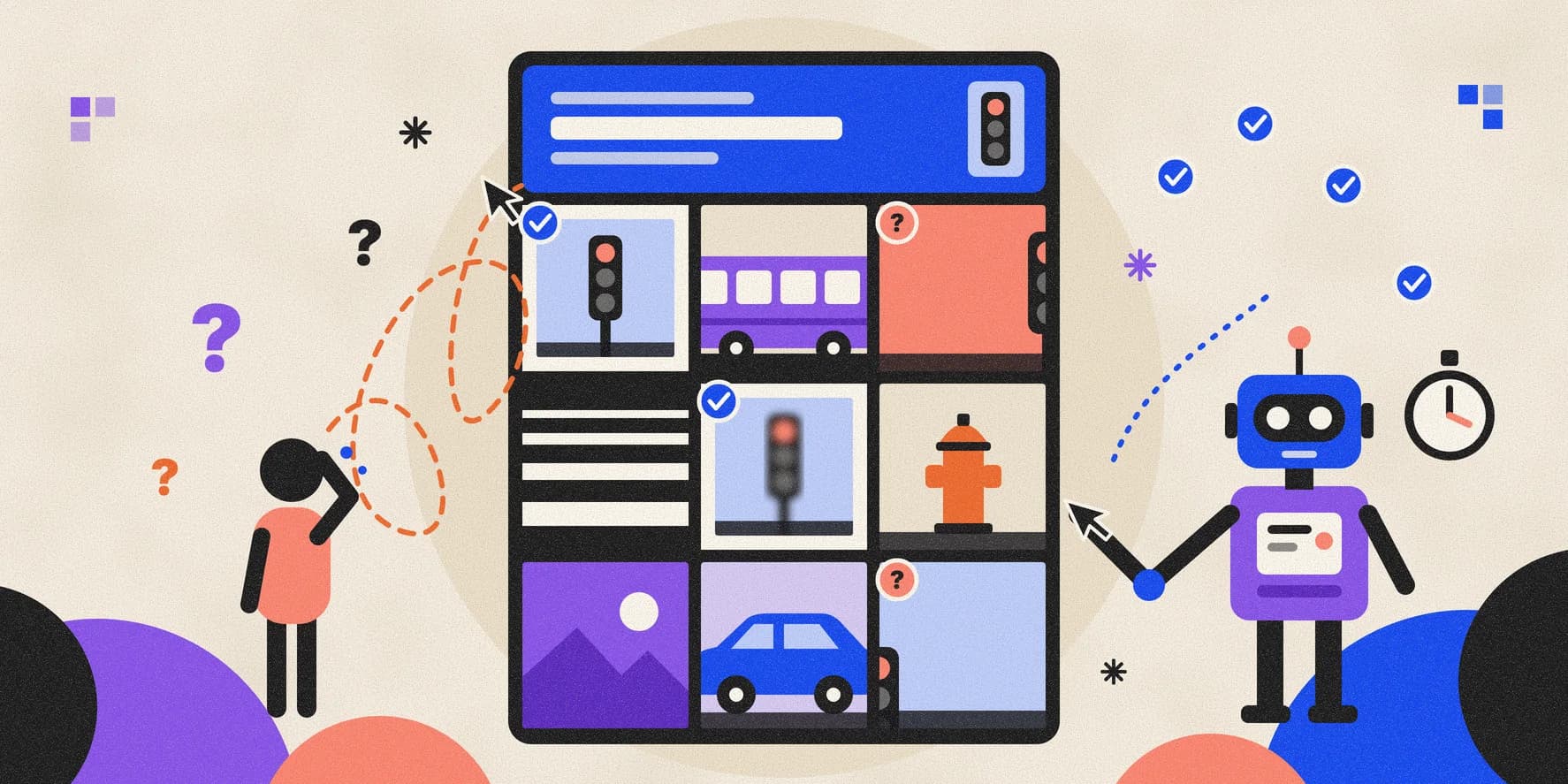
Photos started to replace text. Find the traffic lights. Select the buses. Mark the crosswalks.
On a phone this felt easier than decoding unreadable letters. The core problem stayed the same, though. Any test built to be easy for people and hard for machines has an expiry date when machines improve in exactly that skill.
Then came the checkbox: “I’m not a robot”
At the end of 2014, Google introduced No CAPTCHA reCAPTCHA, the well-known “I’m not a robot” checkbox.
At first glance it looks almost like a joke. If a bot can click a button, what good is a button that asks if you are a bot?
The answer is that the click itself was never the whole test.
Google explained that reCAPTCHA uses a risk analysis system. It watches how the user interacts with the page before, during and after the check. When the system judges a visit as legitimate, one click is enough. When it has more doubt, the user gets an extra challenge with images.
A few years later came reCAPTCHA v3, where the user does not solve any visible test at all. Instead, the system returns a risk score for each interaction. The site owner decides what to do with the more suspicious requests.
Step by step, CAPTCHA stopped being a question we answer. It became a system that scores us in the background.
Now the best part: bots sometimes solve CAPTCHAs better than people
This is no longer just an internet joke.
A study presented at the USENIX Security conference in 2023 had 1,400 participants, who solved 14,000 CAPTCHAs in total. The researchers then compared the human results with automated attacks from earlier research.
On image-based CAPTCHAs, average human accuracy was roughly 71% to 81%. The exact number depended on the system. The automated attacks in the comparison reached 85% to 100% accuracy on the different systems, and most of them scored above 96%. For some types, bots were also much faster.
This does not mean that any bot today passes any CAPTCHA with ease. The study compares specific CAPTCHA systems with the best known attacks from the research literature. Its results do not apply to every site and every kind of protection.
But the result shows the problem well.
A test built on the idea that people have a clear advantage over computers can no longer always count on that advantage.
For some people, the problem was there from the start
There is one more reason why the CAPTCHA story is about more than annoying traffic lights.
For years, the W3C has warned about the problems CAPTCHA systems create for people with disabilities. Visual tests can shut out blind people and people with low vision. They can also block some people with cognitive disabilities, such as dyslexia. Audio CAPTCHA brings a whole different set of problems.
That is why accessibility guidelines ask for alternatives. When a site uses CAPTCHA, it has to offer the task in more than one form, for example as an image and as sound.
In other words, the question “are you human?” was never equally simple for all people.
The future of CAPTCHA probably looks like no CAPTCHA at all
One of the more interesting directions today is to drop classic visual puzzles completely.
In 2023, Cloudflare announced that it had stopped using traditional visual CAPTCHAs on its network and replaced them with a system called Turnstile. Turnstile does not ask you to find buses and traffic lights. It runs a series of checks in the browser and reads signals about the environment to judge the request. In most cases the user does nothing. In some cases a simple checkbox appears.
Its documentation lists what it checks: browser features, support for certain web APIs, and small computing challenges that run in the background.
The irony is hard to miss. For decades we designed more and more complicated tasks that only a person can solve. Now we have systems that try to confirm we are human by not asking us anything at all.
So, are we done with traffic lights?
Not yet.
Visual CAPTCHAs still exist. Different sites use different generations and versions of systems that protect them from automated abuse.
The trend, however, is clear. For years Google has offered checks based on risk scores that do not have to interrupt the user. Cloudflare openly presents its system as an alternative to CAPTCHA puzzles.
The most interesting part is how much the original question has changed.
In the early 2000s, the job was to find a task that a person can solve and a computer cannot.
Today computers read text, classify images and automate much of what once served as proof of being human. That is why protection keeps moving from “can you solve this task?” to “does this interaction look like legitimate activity?”
And that is maybe the best proof of how much the internet has changed in the last twenty years.
CAPTCHA was built to find what people do better than computers.
Today one of its biggest problems is that this list has become much shorter.