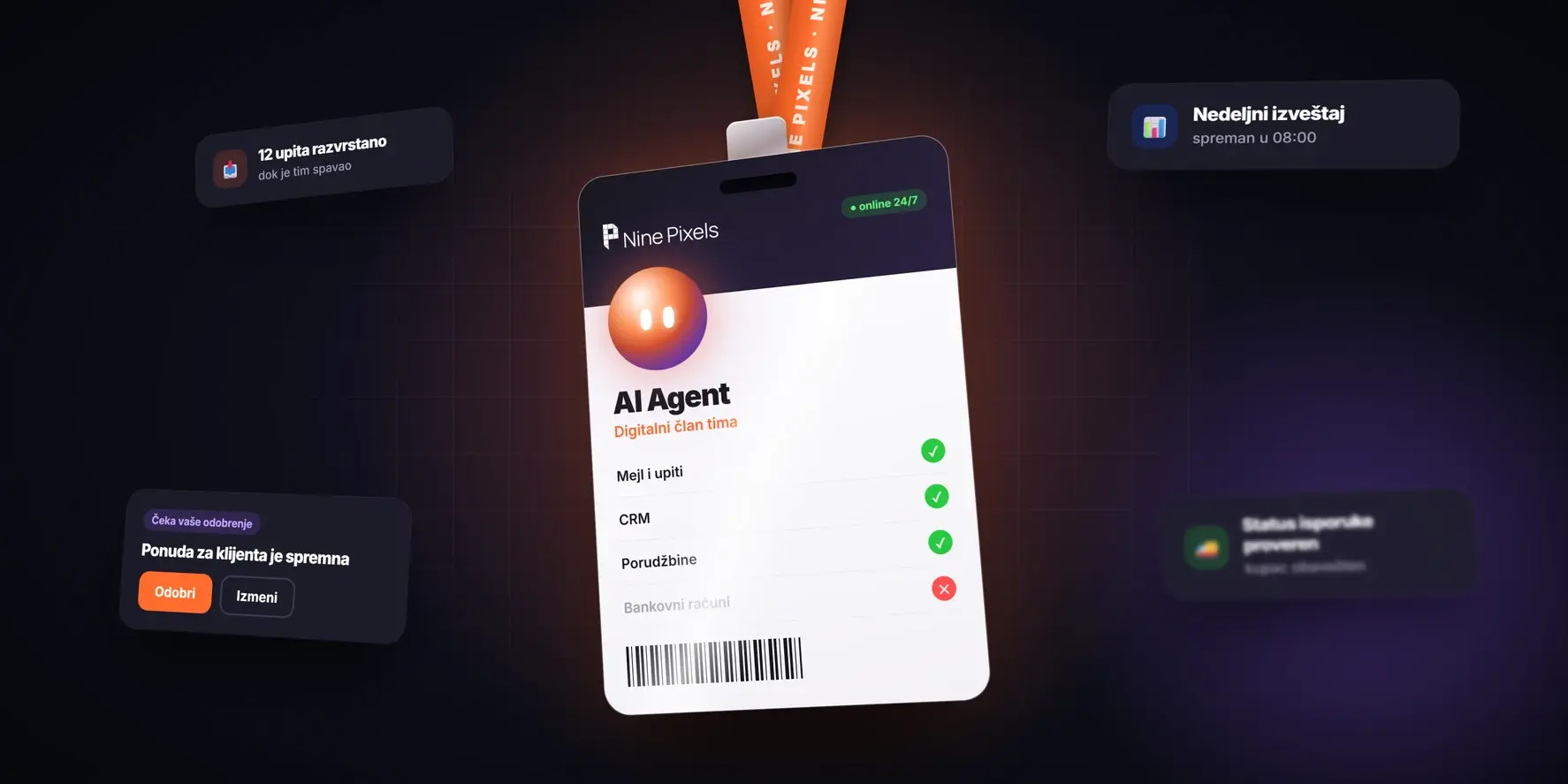
Nobody on the team worked over the weekend, and you did not hire anyone new. The answer is simple: an AI agent did part of the work.
People have talked about artificial intelligence for years, but the way companies use it is slowly changing. Most of us know AI as a tool: we ask a question and get an answer. Now more attention goes to systems that take on specific tasks and join everyday business processes. That is where AI agents come in. With the right integrations and clear rules, they can become a kind of digital team member.
What are AI agents, and how do they differ from ChatGPT?
Most of us have used ChatGPT or a similar AI tool at least once. We ask it to write an email, analyze a document, translate a text or help with an idea. Then we use the result in our own work. But when the conversation ends, the next steps are usually up to us.
AI agents work a little differently. They do not have to stop at an answer. They can use different tools, look up information and carry out tasks inside the systems they connect to.
Say your company gets a large number of inquiries from potential clients every day. ChatGPT can help you write a reply to each email. You still have to enter the details into the CRM, check earlier messages and set a reminder for the next contact. An AI agent with the right access can do several of these steps as one process. It leaves you only the decisions that need human judgment.
AI agents also differ from classic automation. Automation mostly follows a fixed sequence of steps. An AI agent can process the information it receives, choose the next step and adapt to the situation. That does not mean an agent is always the better choice. For simple, predictable tasks, classic automation is often more reliable, cheaper and fully sufficient.
How can AI agents help your team?
The biggest benefit of AI agents is not that they do tasks instead of people. They take over part of the work that eats up your employees’ time every day. Almost every company has processes that repeat, pull information from several sources or involve many administrative steps.
In sales, an AI agent can help process new inquiries, gather information about potential clients, update the CRM and draft offers. Picture a sales team that gets a summary every morning: new contacts, what they need and the suggested next steps. Nobody has to go through the inbox by hand. The team spends more time with clients and less time on paperwork.
In customer support, agents can answer common questions, check order status and help with simple requests. Say a customer wants to exchange a product. An agent connected to the web shop and the business systems checks the earlier purchase, the stock of another size and the exchange terms. Then it drafts a reply or starts the exchange, if it has permission to do so. Harder cases go to an employee, together with all the information the agent has already collected.
In e-commerce, the options are especially interesting. A web shop handles a lot of data every day about products, customers, orders and stock. An AI agent can help check product information, spot incomplete descriptions or find mismatches between systems. If some products lack attributes or have data that does not match, the agent can prepare a list of issues for employees to check.
In administration and internal processes, agents can collect data from different documents, prepare reports, organize tasks and help employees find information faster. Some jobs used to mean three steps: open several spreadsheets, find the right numbers and combine them by hand. In some cases, an agent makes that work much faster.
All of this assumes the agents are built properly and connected to the systems the company uses. An AI model on its own, without access to the right data and integrations, cannot do these tasks.
Can one AI agent do several different jobs?
It can, but that does not mean you have to give it everything. Depending on what the company needs, you can build one agent that handles several related tasks. You can also build a system in which a few specialized agents work together.
For example, one agent handles sales inquiries, a second checks information in the business systems and a third prepares replies or reports. This approach is called a multi-agent system. Its advantage is that it splits a complex process into smaller, clearly defined tasks.
Still, more agents do not automatically bring better results. Each new agent makes the system more complex. So you need to define carefully who is responsible for what, how agents share information and how you control them. For many companies, one well-designed agent is enough, especially at the start.
Do AI agents replace employees?
One question comes up every time we talk about AI agents: what happens to employees? If a system can process emails, prepare reports and talk to customers, it is natural to ask what role people keep in those processes.
Some work will certainly change, and people will see more and more of the tasks they did by hand for years become automated. But automating single tasks is not the same as replacing a whole job.
Take an account manager. An AI agent can write a meeting summary, organize tasks, track deadlines and list the questions the client still has no answer to. But to understand the client relationship, negotiate, set priorities and decide in unexpected situations, a person needs experience and responsibility. Those are hard to hand over to software.
So it makes more sense to see AI agents as support for employees, with the knowledge that they will affect different jobs in different ways. Used well, they free up the time people now spend on repetitive tasks. People can then focus on the work where their knowledge and experience matter most.
What happens when an AI agent makes a mistake?
Like any other software, AI agents have limits. They can misread a request, use wrong data or suggest a step that does not fit the situation. The difference is that an agent with access to business systems can also act. So the cost of a mistake can be much higher than a badly written reply.
Before you introduce an agent, define clearly what it can do on its own, what information it can access and when it needs human approval. For example, an agent can prepare an offer from your existing price list. A special discount or a contract commitment stays with the person responsible for it.
The company also needs a way to follow what agents do, check their results and react when something does not work as planned. Data protection, secure integrations and limited access to sensitive information need special attention.
After all, nobody gives a new employee access to every company system on day one. A digital colleague deserves the same caution.
How do you know if your company needs AI agents?
Before you think about AI agents, look at how your business processes work today.
- Which tasks repeat every day?
- Where do employees spend the most time?
- Do people enter the same information into several systems by hand, and how often does that cause errors?
Tasks like these are often a good place to start with automation. They are especially good candidates when the task repeats often enough, relies on data you already have and has a result you can clearly check.
Do not ignore the cost either. Building and running AI agents costs money. The price depends on how complex the tasks are, which integrations you need, how much data there is and how you maintain the agent. So it is not enough to ask what the technology can do. Ask whether it will really save time, reduce errors or improve your service.
The best approach is often to start with one specific process and see how the solution works in practice. Only then think about automating more. There is no need to change how the whole company works at once, especially if you are not yet sure where AI helps you most.
Where does Nine Pixels fit in?
We build web shops, apps and other digital products, and we often meet companies with similar problems. Their information sits in several systems that do not talk to each other. Employees spend a large part of their day on administrative tasks. Existing processes need much more manual work than they have to.
That is why we find AI agents most interesting as part of a wider digital transformation of a business. Generating answers is the smaller part of their value. The larger part is that they connect to the tools and systems you already use, understand specific tasks and help employees in their daily work.
Sometimes that means connecting an AI agent to a CRM, sometimes to a web shop or an ERP system. Sometimes it means building a custom solution that brings several business processes together. In every case, we first need to understand how the company works and where there is room to improve.
Are you thinking about AI agents for your business? You do not need to know in advance which technology you need or what the whole solution looks like. It is enough to spot a task that takes too much of your team’s time, or a process you believe can work better.
Get in touch, and we will look at it together. Is an AI agent the right solution for your business, and how can we connect it to the systems you already use?