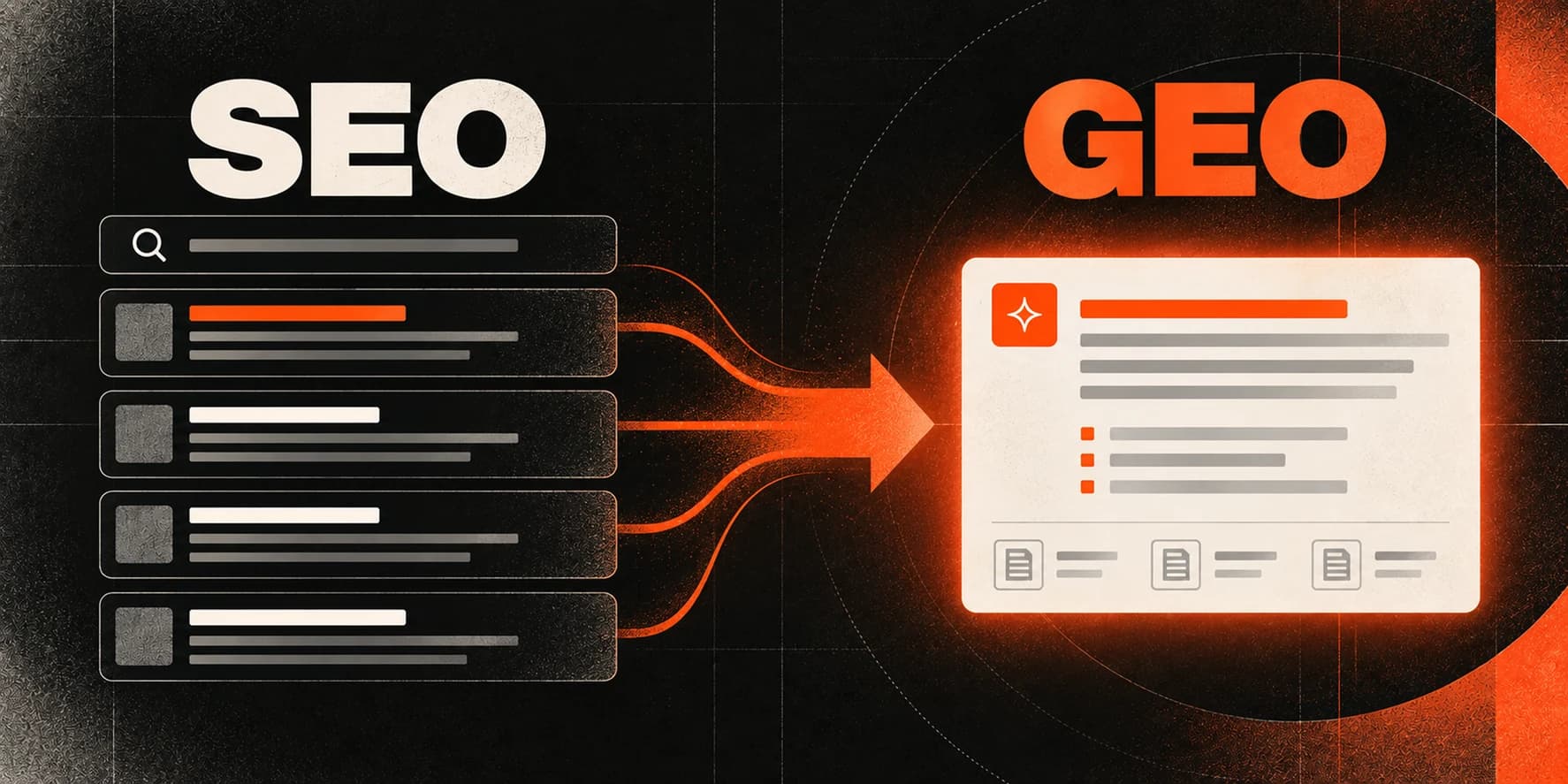
That's where GEO comes in.
What is GEO?
GEO stands for Generative Engine Optimization, and it refers to optimizing content so generative systems can find, understand and use it more easily as a source when forming an answer. Put simply, SEO tries to get you the best possible visibility in search results, while GEO tries to make your brand, site or content part of the answer an AI generates.
If someone searches Google for “agency for building an eCommerce site,” the goal of classic SEO is for your site to rank as well as possible among the results. But if someone asks an AI “Which company in Serbia can I hire for a complex eCommerce project?”, the situation is different. The user may never see ten results at all. The AI can analyze multiple sources, put together an answer, and mention a few companies it considers relevant.
So the new question is no longer just: are we on Google? It's also: does AI even know we exist?
Does GEO replace SEO?
No. And this is probably the single most important thing to understand.
GEO is not a replacement for SEO. A large share of the things that help a site show up in generative search are the same things that have made SEO good for years: quality content, a clear site structure, a solid technical foundation, relevant information, domain authority, and pages that answer users' real questions.
Google itself treats GEO and similar terms as part of SEO, not as an entirely new discipline separate from it. To appear in Google's AI features, a page still has to be accessible to Google, indexed, and eligible to show up in search.
What has changed is how content gets used once it's found. In classic search, we fought for the click. In AI search, we're also fighting to be the source.
How does AI pick the information it uses?
There's no single algorithm that every AI system uses, and no universal formula that guarantees you'll show up in the answer. Google's AI features, ChatGPT Search, Perplexity and other systems don't have to use the same sources or rank them the same way.
But they do have one thing in common: to use you as a source, they first have to be able to find and understand the information you publish.
That's why a site that clearly states “Nine Pixels is a company that builds websites, eCommerce platforms, apps and business software” sends a far clearer signal than one that only says “We turn ideas into unforgettable digital experiences.” The second sentence might sound nicer, but the first explains far more precisely who you are and what you do. Ideally, you have both.
What does GEO change on a website?
It doesn't mean we should start writing content for robots. Quite the opposite. Good content should become even more specific, more expert and more useful to people. But there are a few things worth paying particular attention to today.
Clearly explain who you are
Your company, products, services, people, locations and projects should be presented consistently across the whole site. If one page calls the company one name and another page uses a different one, and nowhere is it clear how the brand relates to the legal entity, you make it harder for systems to connect the information.
That's why an About page is no longer just a place for a team photo and a few nice sentences. It becomes an important source of context about who is behind the site, what the company actually does, and how it connects to its products, services and projects.
Answer the questions people actually ask
People no longer turn to search with just keywords. We used to type “Magento price Serbia.” Today we're far more likely to ask: “Is Magento worth it for a webshop with 30,000 products and an ERP integration?”
That means content needs to answer more complex questions that users actually ask. A blog post like “Magento or Shopify: which is better for large eCommerce?” can carry far more value than ten short posts built around slight variations of the same keyword.
Show experience, not just claims
Anyone can write on their site that they're an expert. It's far more valuable to show what you've actually done. A case study that explains the client's problem, the technology you chose, why you chose it and the project's result gives search engines and AI systems far more concrete context than a page that just says “We build outstanding digital products.”
Original research, data, project experience, comparisons and expert opinions also produce content that isn't just a copy of what already exists on a hundred other sites.
Site structure still matters
AI is not a reason to forget technical SEO. Quite the opposite. Pages should be accessible to crawlers, connected through internal links, logically organized, and clear enough for a system to determine what each page's main topic is.
Headings, URL structure, title and description tags, sitemaps, canonical tags, speed, mobile experience and indexing haven't suddenly stopped mattering. It's hard to build anything on top of a foundation that isn't solid.
Structured data helps, but it's not a magic button
Schema markup can help a search engine understand the data on your site more precisely — a company, a product, an article, an event. But there's no special “GEO schema” you can add and wake up the next morning featured in every AI answer.
In other words, structured data makes sense when it precisely describes content that actually exists on the page, not when it's used to try to fool the system.
Be accessible to the systems you want to find you
One often-overlooked part of GEO is purely technical. If a system's crawler can't access your site, that system is unlikely to use your content as a source.
That's why robots.txt is no longer just Googlebot's concern. It's worth checking who you're letting access your site, and whether those settings match what you're actually trying to achieve.
What about llms.txt?
If you've read about GEO optimization over the past few months, you've probably come across the advice that every site needs to get an llms.txt file right away.
Not quite.
There's currently no evidence that adding such a file will, on its own, increase a site's visibility in generative results. That doesn't mean the way AI systems access the internet won't keep evolving — just that there's currently no reason to chase every new term that shows up on LinkedIn.
How do you measure GEO?
With SEO, we're used to rankings, impressions, clicks and organic traffic. With GEO, measurement is more complicated, because an AI answer can change depending on how a question is phrased, when it's asked, which sources are available, and which system the user is using.
So it's not enough to ask ChatGPT about your company once and conclude that GEO “works” or “doesn't work” for you. You need to track whether your brand shows up in relevant AI answers, whether it's cited as a source, which topics systems associate it with, how much traffic comes from AI platforms and, maybe most importantly, whether the information AI gives about your company is accurate.
All of that should be looked at alongside classic SEO metrics, since the two areas increasingly overlap.
So is SEO no longer enough?
If by SEO we mean stuffing a keyword into a text five times and trying to rank first on Google, then no, it isn't. But good SEO has not been just that for a long time.
A technically solid site, a clearly defined brand, original content, useful information, authority and an understanding of user intent matter more today than ever. GEO just adds one more question: can our content become part of the answer, not just part of the list of results?
Companies that start thinking this way early won't have to choose between SEO and GEO. They'll do both. Because whether someone types something into Google or asks an AI the same question, the goal in the end is the same: to be found the moment someone is looking for exactly what you offer.